Chichicastenango is a K’iche’ Maya town in the El Quiché highlands, at 1,965 m, best known for the market that fills its centre every Thursday and Sunday, one of the largest in Central America. It is also a centre of living Maya-Catholic religion: K’iche’ families burn copal on the steps of the Santo Tomás church, daykeepers make offerings at the Pascual Abaj shrine, and it was here that the Popol Vuh, the K’iche’ creation epic, came to light. Most travellers visit on a market-day trip from Lake Atitlán or Antigua.

Chichicastenango: a K’iche’ market town in the highlands
Chichicastenango, usually shortened to Chichi, sits at 1,965 m in the department of El Quiché, an hour north of Lake Atitlán. It is a K’iche’ Maya town, and twice a week its grid of streets becomes the trading floor for villages across the western highlands.
Two things overlap here and make the town more than a shopping stop: the market, which has run on this site for centuries, and the religious life around the church of Santo Tomás, where Maya and Catholic practice have been braided together since the colonial period. Arriving on a Thursday or Sunday means seeing both at full tilt.
A short history: from Q’umarkaj to the Popol Vuh
Before the Spanish, this was K’iche’ country. Their capital, Q’umarkaj (also called Utatlán), stood near today’s Santa Cruz del Quiché, a short distance north. In 1524 Pedro de Alvarado captured and burned it; survivors and allied groups were resettled in surrounding towns, Chichicastenango among them, under Dominican friars.
That resettlement is why Chichicastenango holds one of the country’s deepest cultural records. Around 1690 the Popol Vuh, the K’iche’ account of creation and the Hero Twins, surfaced here; the Dominican friar Francisco Ximénez transcribed and translated the K’iche’ text at the parish in the early 18th century, which is the only reason it survives. The town’s cofradías, lay religious brotherhoods that rotate care of the saints, have kept the older practices alive alongside the church ever since.
The market: what to see and buy
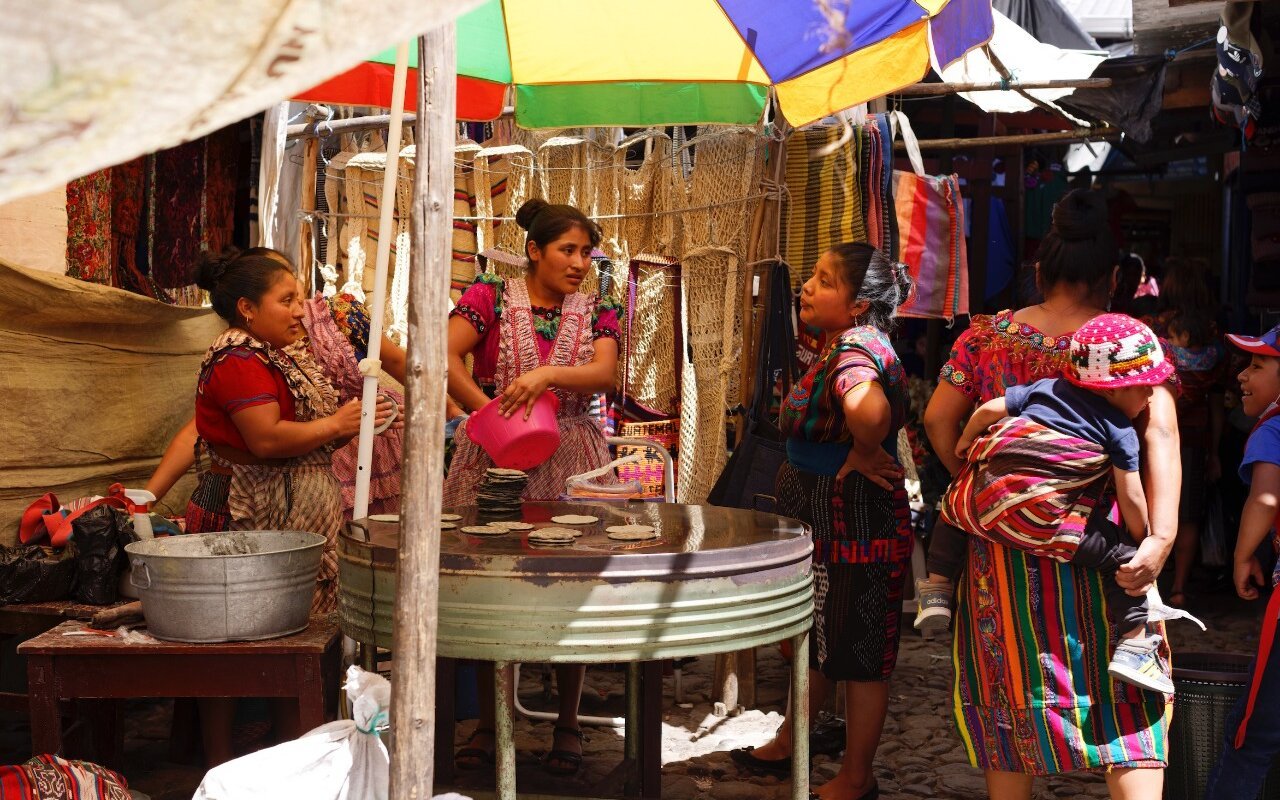
The market takes the central plaza and the streets around it from early morning to mid-afternoon on Thursdays and Sundays. One half serves the town, produce, flowers for the church, household goods; the other draws the highlands’ crafts for visitors.
- Textiles: huipiles and shawls woven on backstrap looms, each pattern and palette tied to a specific village, so a trained eye reads where a piece is from.
- Wooden masks: carved for the region’s traditional dances, a Chichicastenango speciality, many made in workshops in the surrounding hamlets.
- Pottery, jade, beadwork, blankets, and bundles of copal incense sold for the church steps.
Prices are negotiable and the light is best early. For the wider picture, see our article on Guatemala’s typical markets.
Santo Tomás and Pascual Abaj: living Maya-Catholic religion
The 16th-century church of Santo Tomás rises above the market on a flight of eighteen stone steps, one for each month of the Maya solar calendar. K’iche’ families burn copal and swing censers on the steps; inside, candles and offerings to ancestors sit alongside Catholic worship, much of it led by the cofradías.
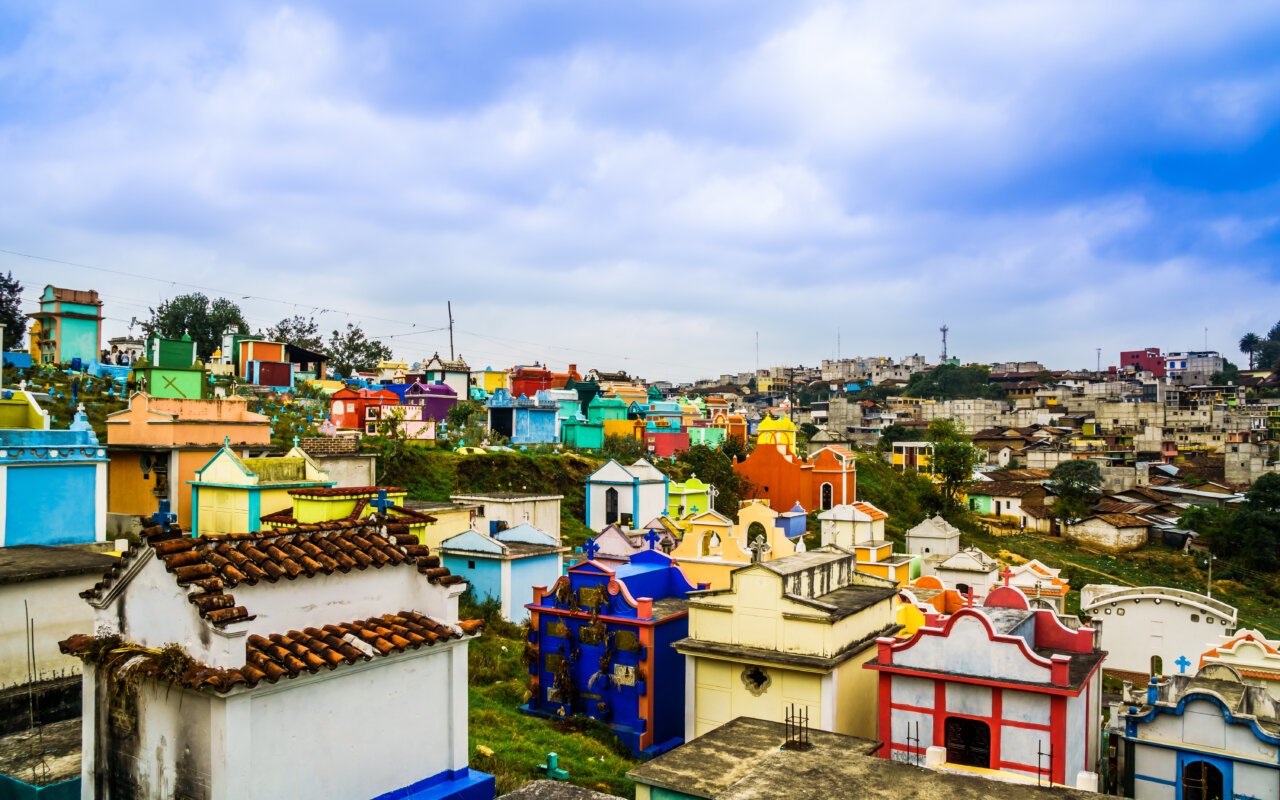
On a hill above town stands Pascual Abaj, a stone idol where ajq’ijab (K’iche’ daykeepers) still make offerings of flowers, incense and alcohol. It is an active shrine, not a monument. The town cemetery, on another rise, is painted in bright blues, greens and whites, the colours carrying meaning for the families who tend the tombs.
Seeing Chichicastenango beyond the stalls
Most visitors see only the craft rows at midday. A little effort reveals the town the K’iche’ use:
- Come the evening before and start at dawn, when sellers are setting up and the upper plaza around Santo Tomás belongs to the town, not the tour buses.
- Choose Sunday for the cofradías, whose members process in traditional dress on the bigger religious days.
- Eat in the market comedores, simple stalls serving caldo and tamales to the traders, rather than the tourist cafés on the square.
- Visit Pascual Abaj with a K’iche’ guide, who can explain the offerings without turning a private ceremony into a show.
- Look past the crafts to the goods the town buys, the pigs, candles, rope and medicinal herbs that show what the market is actually for.
Where Chichicastenango fits in a trip
Because it runs on market days, Chichicastenango belongs in a wider highlands route rather than a stay of its own. It pairs naturally with Lake Atitlán an hour south and Antigua, giving a cultural arc from colonial city to lake to living Maya town. It features in several of our itineraries:
- Panorama of Guatemala: a two-week highlands-and-Maya loop.
- Wonders of Guatemala: the headline sights, markets included.
- Family tour: the essentials at a gentler pace.
See all our regions of Guatemala to build the rest of the route.
How to get to Chichicastenango
Chichicastenango is almost always a day trip, timed to the Thursday or Sunday market; other days the centre is quiet.
| From | Distance | Time | Notes |
|---|---|---|---|
| Panajachel (Lake Atitlán) | ~40 km | 1 h 15 | Closest base; easy half-day combination |
| Antigua | ~95 km | 2 h 30 | Common market-day trip |
| Quetzaltenango (Xela) | ~95 km | 2 h 15 | Western-highlands loop |
| Guatemala City | ~140 km | 3 h | Via the Pan-American Highway |
Shuttles run from Antigua and Panajachel on market mornings and return in the afternoon.
FAQ: Chichicastenango
What days is the Chichicastenango market?
Every Thursday and Sunday, from early morning to mid-afternoon. These are the only days worth visiting; the town is quiet otherwise.
Why is Chichicastenango important to Maya culture?
It is a centre of living K’iche’ Maya religion, where cofradías and daykeepers keep older practices alongside the Catholic church, and it is where the Popol Vuh, the K’iche’ creation epic, came to light around 1690.
What can you buy at the market?
Highland textiles such as huipiles and shawls, carved wooden masks, pottery, jade, beadwork and blankets, alongside the produce and goods that serve the town itself. Prices are negotiable.
What is Pascual Abaj?
A Maya shrine on a hill above town, centred on a stone idol, where K’iche’ daykeepers still make offerings. It is an active religious site; visit with a local guide and keep a respectful distance.
Can you visit Chichicastenango as a day trip?
Yes, and most people do, from Lake Atitlán (about an hour) or Antigua (about 2 h 30), timed to a market day. Shuttles run on market mornings.
Where was the K’iche’ Maya capital?
At Q’umarkaj, also called Utatlán, near today’s Santa Cruz del Quiché, north of Chichicastenango. Pedro de Alvarado captured and burned it in 1524.
Can you take photos in Chichicastenango?
In the market, generally yes, though asking first is courteous, especially of people. Inside the Santo Tomás church and during ceremonies, photography is restricted and should be avoided.
Last updated: October 2026
About the author
Tristan Reger is co-founder of Terra Guatemala, a local travel agency based in Antigua. He runs the highland market routes and works with K’iche’ guides in Chichicastenango to show the town beyond its stalls.
Sources
- Encyclopaedia Britannica (Chichicastenango)
- INGUAT, Instituto Guatemalteco de Turismo
- Popol Vuh, trans. Francisco Ximénez (historical record)
- Field observations, Terra Guatemala, 2026